What Actually Happens Inside Your Body When You Get "Glutened" (It's Worse Than You Think)
This post may contain affiliate links. Please read our disclosure policy.
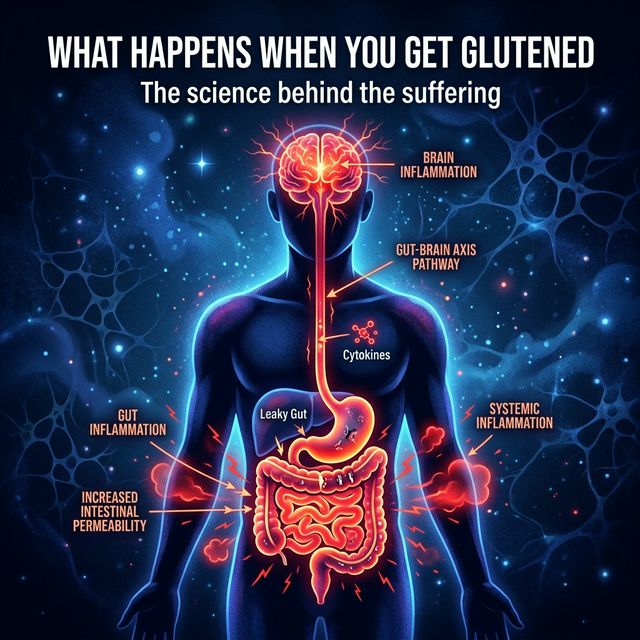
You ate gluten by accident. Within minutes, your body launches a full-scale war against itself. Here is exactly what happens inside you—hour by hour—and why it takes weeks to recover.
Want to save this recipe?
Enter your email and we'll send it to you! Plus, get new recipes every week.
It's Not "Just a Stomachache."
Every celiac has heard it.
"You accidentally ate a crouton? Come on, it can't be THAT bad."
Oh, but it can. And it is. And unless you've lived it, you have no idea what "getting glutened" actually does to a human body.
This article is for two groups of people:
Let's walk through what happens, hour by hour, when a celiac accidentally eats gluten.
Hour 0: The Moment of Contact
You bite into something. Maybe it looked safe. Maybe the restaurant said it was gluten-free. Maybe you forgot that soy sauce has wheat. Whatever the reason, gluten has entered your body.
At this moment, you feel nothing. You're blissfully unaware that a war is about to begin.
The gluten protein (specifically, a component called gliadin) is uniquely resistant to human digestion. Unlike most proteins, your stomach acid and digestive enzymes cannot fully break gliadin down. Large, partially digested fragments survive the journey through your stomach intact.
Hours 1-2: The Breach
Those undigested gliadin fragments arrive in your small intestine. In a healthy person, the intestinal lining is a tight, well-organized barrier—the cells are locked together like a brick wall, controlling exactly what passes through into your bloodstream.
In a celiac, gliadin triggers the release of a protein called zonulin. Zonulin does something terrifying: it unlocks the "gates" between your intestinal cells. The tight junctions loosen. The brick wall develops cracks.
Now gliadin fragments leak through those cracks into the tissue underneath your intestinal lining. They've breached the wall.
This is why celiac disease is sometimes called an "intestinal permeability" disorder—your gut becomes literally leaky.
🔍 Still reading labels the hard way?
Check Gluten scans any food label in 3 seconds and tells you exactly what's safe. Trusted by celiacs worldwide.
Hours 2-4: The Alarm Goes Off
Once gliadin fragments are through the barrier, they meet an enzyme called tissue transglutaminase (tTG). This enzyme modifies the gliadin fragments, making them even MORE visible and threatening to your immune system.
Your immune cells—specifically your T-cells—recognize the modified gliadin as a dangerous foreign invader. In reality, gliadin is just a food protein. It's not dangerous. But your immune system has been genetically programmed to see it as a lethal threat.
The alarm goes off. Your immune system activates a full inflammatory response against the lining of your own small intestine. This is the autoimmune part of celiac disease: your body isn't attacking the gluten. It's attacking itself.
This is when you start to feel it. The first wave of symptoms hits:
Hours 4-12: The Destruction
Your immune system is now in full assault mode. Inflammatory chemicals (called cytokines) flood the area. White blood cells attack the villi—the tiny, finger-like projections that line your small intestine and absorb nutrients from food.
Imagine your small intestine is a shag carpet. The villi are the fibers. Your immune response is essentially taking a lawnmower to that carpet.
This process is called villous atrophy and it is the hallmark damage of celiac disease.
As villi are flattened and destroyed, your ability to absorb nutrients drops dramatically. Meanwhile, the inflammation causes:
Hours 12-48: The Aftermath
The active immune assault begins to subside, but the damage is done. Your intestinal lining is inflamed, swollen, and in some areas, the villi have been completely flattened.
During this phase, you may experience:
📩 Want more tips like this?
Join celiacs getting weekly gluten-free tips, recipes, and hidden gluten alerts.
No spam. Unsubscribe anytime.
Days 3-14: Recovery Mode
Your body shifts from active battle to repair mode. Intestinal stem cells begin regenerating new villi. The inflammatory chemicals slowly clear. Your gut permeability (the "leaky gut" caused by zonulin) gradually tightens back up.
But this takes time. Studies show:
This is why celiacs take their diet so seriously. It's not about the stomachache tonight. It's about the weeks of damage and recovery that follow.
The Cumulative Effect: Why "Just a Little" Is Never Fine
If a celiac is repeatedly exposed to small amounts of gluten—say, from a shared toaster, or from a "gluten-free" restaurant that doesn't actually prevent cross-contamination—the intestine never fully heals. The villi stay flattened. Nutrient absorption stays impaired.
Over months and years, this leads to:
This is why "just a crumb" matters. This is why we interrogate waiters. This is why we can't "just pick the croutons off."
What to Do Right Now If You've Been Glutened
You can't undo it, but you can support your body through recovery:
For a full recovery protocol, read our detailed guide: I Accidentally Ate Gluten: What to Do Right Now.
Share This With Someone Who Doesn't Understand
If you have a friend, family member, partner, or coworker who thinks celiac disease is "no big deal" or that you're "being difficult"—send them this article. Sometimes people need to understand the science before they understand the suffering.
Celiac disease is not a food trend. It's not a lifestyle choice. It's an autoimmune disease that causes measurable, visible, physical destruction to a vital organ every single time gluten enters the body.
And the best way to make sure it never enters your body by accident? Check Gluten scans any food label in seconds and catches hidden gluten sources that even experienced celiacs miss. Because prevention is always better than a 2-week recovery. Always.
🔍 Not sure about a product?
Check any food label instantly with our free AI gluten scanner — detects 500+ hidden gluten sources in 3 seconds.
Find Gluten-Free Health on Amazon
Shop certified gluten-free options
Top Gluten-Free Picks
📢 Found this helpful? Share it!
Stop Guessing. Start Scanning.
Every ingredient label has hidden gluten risks. Check Gluten's AI catches them all — in 3 seconds flat.
Camera + text input
Priority support
No credit card required • Cancel anytime
The Ultimate Celiac Survival Bundle
Stop stressing over cross-contamination and what to make for dinner. Get our complete 500+ recipe cookbook, dining out guide, and label reading cheat sheets.
200+ GF Baking Recipes
& Fast Food Protocols
Instant PDF Download • 60-Day Money Back Guarantee
About the Author
Sarah Mitchell
Lead Content Writer & Nutritionist, B.S. Nutrition Science
Sarah was diagnosed with celiac disease in 2018 and writes evidence-based guides combining clinical nutrition knowledge with 6+ years of personal gluten-free living experience. All health content is medically reviewed by our advisory team.
Meet our full team →Medical Disclaimer: This article is for informational purposes only and is not a substitute for professional medical advice. Always consult your physician or a registered dietitian before making dietary changes related to celiac disease or gluten sensitivity. Read full disclaimer.
Related Articles
Still Sick on a Gluten-Free Diet? 10 Reasons Your Celiac Symptoms Won't Go Away (2026)
You have been strictly gluten-free for months. Your bloodwork is improving. But you still feel terrible — bloating, fatigue, brain fog. Before you panic, here are the 10 most common reasons celiacs still feel sick on a GF diet.
Celiac Disease & Bone Health: The Osteoporosis Risk Nobody Warned You About (2026)
At 34, my doctor told me I had the bones of a 65-year-old. My DEXA scan showed osteopenia in my spine and hips — years of undiagnosed celiac had silently stolen my bone density. Here is why every celiac needs a bone density scan.
Celiac Disease & Your Teeth: Enamel Defects, Canker Sores, and Signs Your Dentist Should Catch (2026)
My dentist noticed the damage before my GI doctor did. Pitting, discoloration, and grooves on my permanent teeth that no amount of brushing could fix. Turns out, my mouth was screaming "celiac" for 15 years before anyone listened.
The Celiac College Survival Guide: Dining Halls, Dorm Life & Social Eating
How to navigate dining halls, dorm kitchens, late-night pizza runs, and social eating as a celiac college student. From meal plans to microwave hacks — everything you need.